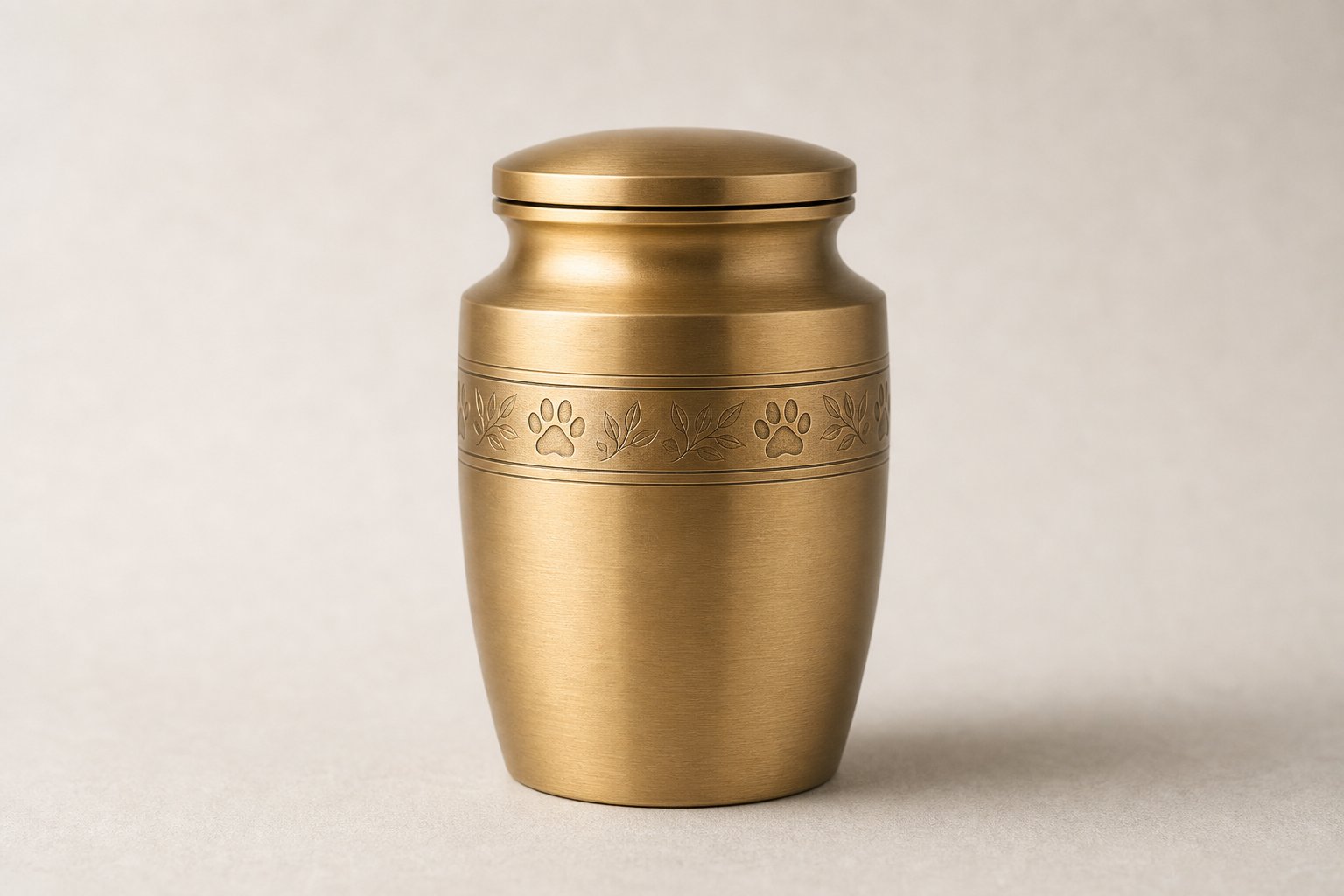
Metal urns occupy the dignified middle of the memorial shelf: heavier in the hand than wood, more forgiving in transit than ceramic, and perceived by many buyers as permanent. Within the metal line, two alloys dominate the purchase conversation — brass and stainless steel. They solve different problems, and the wrong choice shows up later as a margin problem, not just an aesthetic one.
Side by side
| Dimension | Brass urns | Stainless steel urns |
|---|---|---|
| Surface character | Warm gold tone; polished, satin or antique finishes; takes enamel inlay | Silver tone; brushed, mirror or powder-coated finishes |
| Weight in hand | Dense; reads substantial at small sizes | Lighter than brass at equal volume; still metallic and solid |
| Corrosion behavior | Lacquered brass holds its finish indoors; unlacquered brass gradually patinas — a look some owners intentionally choose | Forms a passive chromium layer; strong resistance to humidity and fingerprints on brushed finishes |
| Engraving | Suited to deep engraving and relief work; contrast fill paints well | Laser engraving excels; deep relief is harder on harder alloy |
| Customization | Engraving, enamel color, two-tone spinning bands | Laser marking, brush-and-polish contrast, powder coating |
| Cost drivers | Raw material priced higher; hand polishing and enamel add steps | Material efficient; simpler finishing; tooling-driven at volume |
| Retail positioning | Traditional, ceremonial, gift-tier | Contemporary, everyday-kept, mid-tier workhorse |
Both lines in our metal urn range run from 200 pieces per SKU, with vertical and horizontal forms, engraved detailing and enamel options; FOB magnitude sits around USD 4-15 depending on size, finish and configuration — a planning range that moves with specifications.
What durability actually means here
An urn's working life is indoors: on a shelf, a mantel, a niche. In that environment both alloys are stable, and the meaningful difference is maintenance of appearance. Lacquered brass keeps its golden surface for years; when lacquer wears off, brass may darken and eventually patina. Stainless steel needs essentially nothing — which is why service providers who ship urns to humid climates often specify it.
One boundary worth stating plainly: neither alloy is designed for ground burial. A metal vessel buried in soil will corrode or persist depending on conditions — either way it defeats the purpose. Families intending interment belong with biodegradable urns or memorial stones; the metal line serves keeping and display.
Where the money goes
- Material. Brass raw material costs more per kilogram than common stainless grades, and brass urns use more of it to feel right in the hand.
- Finishing steps. Polishing, lacquering and enamel firing each add labor; brushed stainless is the leanest line to run.
- Tooling and volume. Spun and stamped forms amortize at volume; deep-engraved brass is more craft-per-unit. This is why engraved brass reads premium — it genuinely costs more to make well.
Metal is also a structural pillar of the category, not a sideshow: material frameworks for pet memorial products routinely count metal among the core groups alongside wood, ceramic and glass (360iResearch, 2025).
Positioning the two alloys in one range
- Lead with brass in ceremony-adjacent channels. Funeral service providers and gift buyers respond to the traditional golden look, especially with engraved name plates.
- Lead with stainless in e-commerce. It ships without finishing complaints, photographs cleanly, and its price band supports ads and free-shipping economics.
- Explain the patina honestly. If you list unlacquered brass, say what it does over time — owners who choose it consider the change part of the memorial.
- Match capacity before alloy. Both metals come in the standard size tiers; sizing errors cost more than material upgrades earn. Cross-check with our urn size chart.
FAQ
Which alloy holds up better over time?
For indoor display, both hold up well. Stainless steel needs no maintenance to keep its look; lacquered brass keeps its finish until the lacquer wears, after which the bare metal may patina. Neither is intended for burial in soil.
Can both be engraved with names and dates?
Yes. Brass suits deep engraving with contrast paint fill; stainless steel engraves cleanly by laser with a subtle tone-on-tone result. Choose by style, not capability.
Why does brass cost more?
Raw material and finishing. Brass stock is priced higher per kilogram, urns use it densely, and polishing, lacquering or enamel work adds labor steps that brushed stainless avoids.
Are metal urns suitable for aquamation remains?
Yes, as vessels — metal is unaffected by the chemistry of the process since it never contacts the remains during processing. Only note that aquamation returns more remains by volume, so check capacity against our size chart before ordering.
Sources & notes: 360iResearch (2025) pet memorial products framework counting metal among core material groups; corrosion and patina behavior described as general metallurgical properties and industry common practice; MOQ and FOB magnitude ranges follow PAWSANGEL metal urn line specifications and vary with configuration.
Deciding between brass and stainless for your range?
Send us your price tier and channel mix; we quote both alloys with samples, engraving options and MOQ from 200 pcs — reply within 12 business hours.