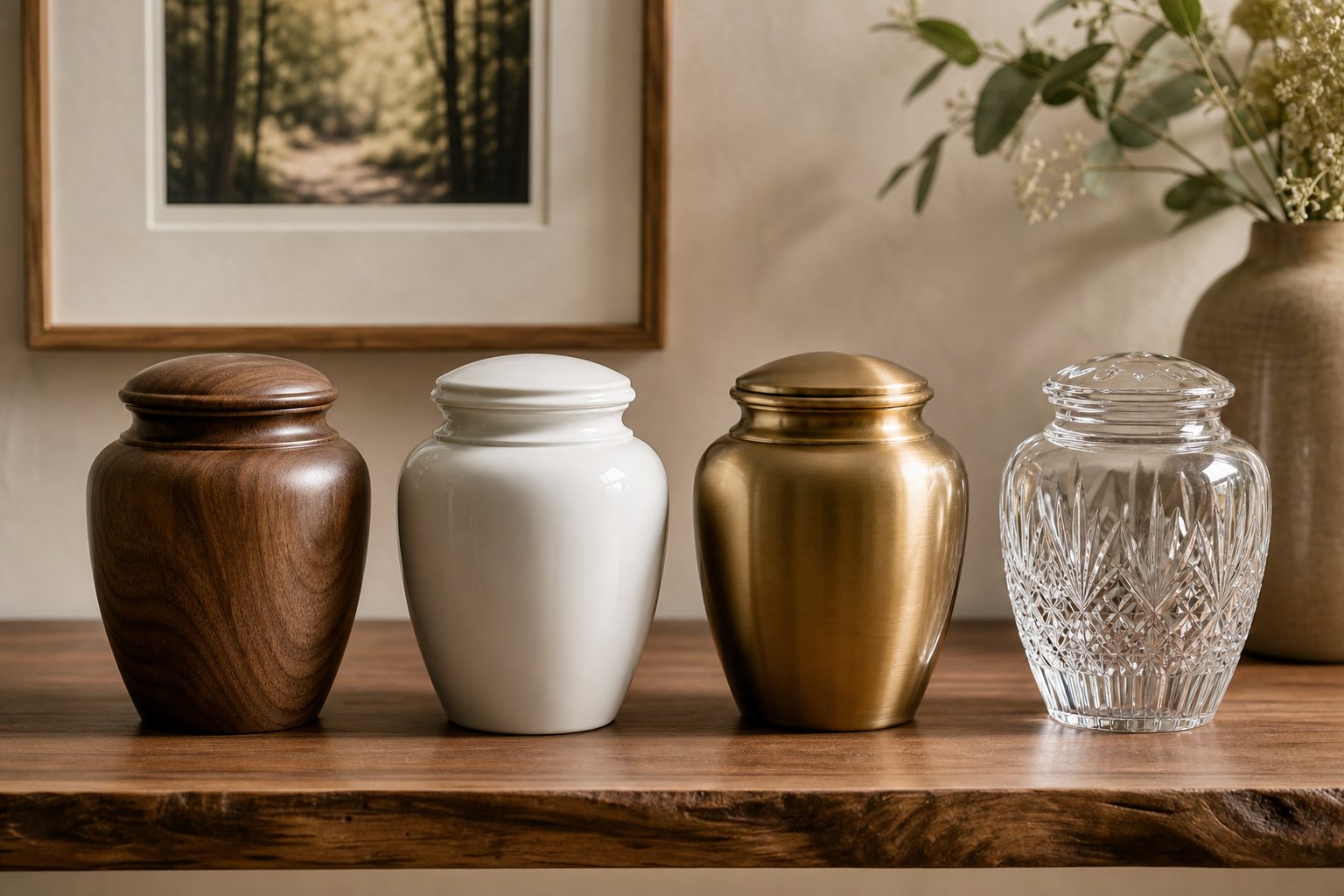
Wood and ceramic are the two material lines most pet memorial retailers start with, and they are more different than their price tags suggest. They come from different industrial clusters, fail in different ways, customize through different processes, and carry different compliance obligations. Choosing between them — or deciding how to split an assortment — is easier once the trade-offs are laid out side by side.
The comparison at a glance
| Dimension | Wooden urns | Ceramic urns |
|---|---|---|
| Look and positioning | Warm, natural grain; engraving-led personalization; vet-clinic and DTC favorite | Glaze color, hand painting, rounded gift forms; premium gift tier |
| Weight and shipping | Light (paulownia especially); panel designs can flat-pack; low freight cost | Heavier and breakable; foam-lined inner box plus double-wall carton required |
| Damage profile | Scratches and dents; visible in finish quality checks | Breakage in transit; controlled by packaging standard and drop testing |
| Customization | Laser engraving of names, dates and paw motifs; painted panels; photo-frame lids | Glaze colors, hand-painted detail, decals, UV photo printing |
| MOQ and FOB magnitude | From 100 pcs; roughly USD 3-12 by configuration | From 200 pcs; roughly USD 2.5-9 by configuration |
| Compliance watch | TSCA Title VI for composite wood sold in the US; wood-source disclosure for the EU under EUDR | Stable lead/cadmium glazes; fragile-goods packaging to marketplace drop-test standards |
| Best fit | Clinics, engraving-led stores, mid-tier assortments, large formats | Gift retail, memorial shops, condolence baskets, premium listings |
FOB figures are magnitude ranges that move with size, finish and packaging — treat them as planning anchors, not quotes.
Two supply chains behind one category
The materials map to different places. Wooden memorial goods draw on the paulownia-processing cluster in Caozhou, Shandong — light, stable timber that has long supplied Japan's casket tradition; an estimated 60 to 70 percent of coffins used in Japan are supplied from this cluster (Japanese Consulate-General in Qingdao, 2024, citing company figures). Paulownia's combination of low weight and clean engraving surface is exactly why it dominates wooden urn programs.
Ceramic urns draw on China's porcelain heartland. Jingdezhen's ceramics industry passed RMB 90 billion in annual output for the first time in 2024 (China.org.cn, 2025), with Chaozhou in Guangdong as the export-scale production base. That depth is what makes small-batch glaze customization economically feasible at pet-urn order sizes.
Compliance differs more than the marketing suggests
- Wood to the US: if the urn uses engineered wood (MDF, plywood), the US formaldehyde rule TSCA Title VI applies — MDF at or below 0.11 ppm — and solid wood avoids the composite-wood question entirely. Ask which construction you are buying.
- Wood to the EU: wood products fall under the EU deforestation regulation, applying to large and mid-sized companies from 2026-12-30 and to micro and small enterprises from 2027-06-30 (European Commission). FSC material supports the due-diligence file; it does not replace it.
- Ceramic to marketplaces: the practical requirement is packaging, not paperwork — individual foam protection and parcels built to survive marketplace drop-test standards (Amazon specifies a 125 cm drop for fragile goods).
- Ceramic glazes: decorative glazes should be specified stable for lead and cadmium where regulations touch decorative articles; your supplier's material declarations are the evidence base.
How to split an assortment
- Wood anchors the mid-tier. Three to five capacity tiers, engraving included, covers clinics and online personalization sales. Start here if you stock only one line — see our wooden urn range.
- Ceramic anchors the gift tier. Rounded heart and figure forms with glaze color photograph well and justify gift-box packaging; browse the ceramic and resin urn category for the shapes that move.
- Personalization differs by material. Sell wood through engraving mockups; sell ceramic through color and form. Your product pages should show the right customization evidence for each.
- Large breeds belong to wood. Beyond roughly three liters, weight and wall strength favor panel wood construction; ceramic XL pieces get heavy and breakage-prone.
FAQ
Which material takes personalization better?
Wood for text: laser engraving renders names and dates crisply and cheaply. Ceramic personalizes better through form and color — hand painting, decals and UV photo printing — rather than deep text engraving.
Which one is cheaper to ship?
Wood, decisively. Paulownia construction weighs a fraction of an equivalent ceramic piece and needs no fragile-goods packaging, which compounds the freight advantage on every parcel.
Which reads as more premium?
Depends on the customer. Ceramic's glaze and hand-painted detail read as artisanal and gift-worthy; solid wood with deep engraving reads as heirloom. Both support premium pricing when the packaging matches the story.
Why are ceramic MOQs higher than wooden ones?
Kiln firing runs in batches, and glaze color consistency is managed per firing cycle. That sets a practical floor on production runs — typically from 200 pieces — while panel-wood construction flexes to smaller batches.
Sources & notes: Japanese Consulate-General in Qingdao (2024) on paulownia casket supply from the Caozhou cluster, citing company figures; China.org.cn (2025) on Jingdezhen ceramics output passing RMB 90 billion in 2024; US EPA on TSCA Title VI limits (MDF 0.11 ppm); European Commission Access2Markets on EUDR application dates; Amazon Seller Central packaging requirements (125 cm drop test for fragile goods). MOQ and FOB magnitudes follow PAWSANGEL product lines and vary with configuration.
Choosing between wood and ceramic for your market?
Send us your price tier and customer profile; we configure a two-material assortment with samples and MOQ from 100 pcs — reply within 12 business hours.