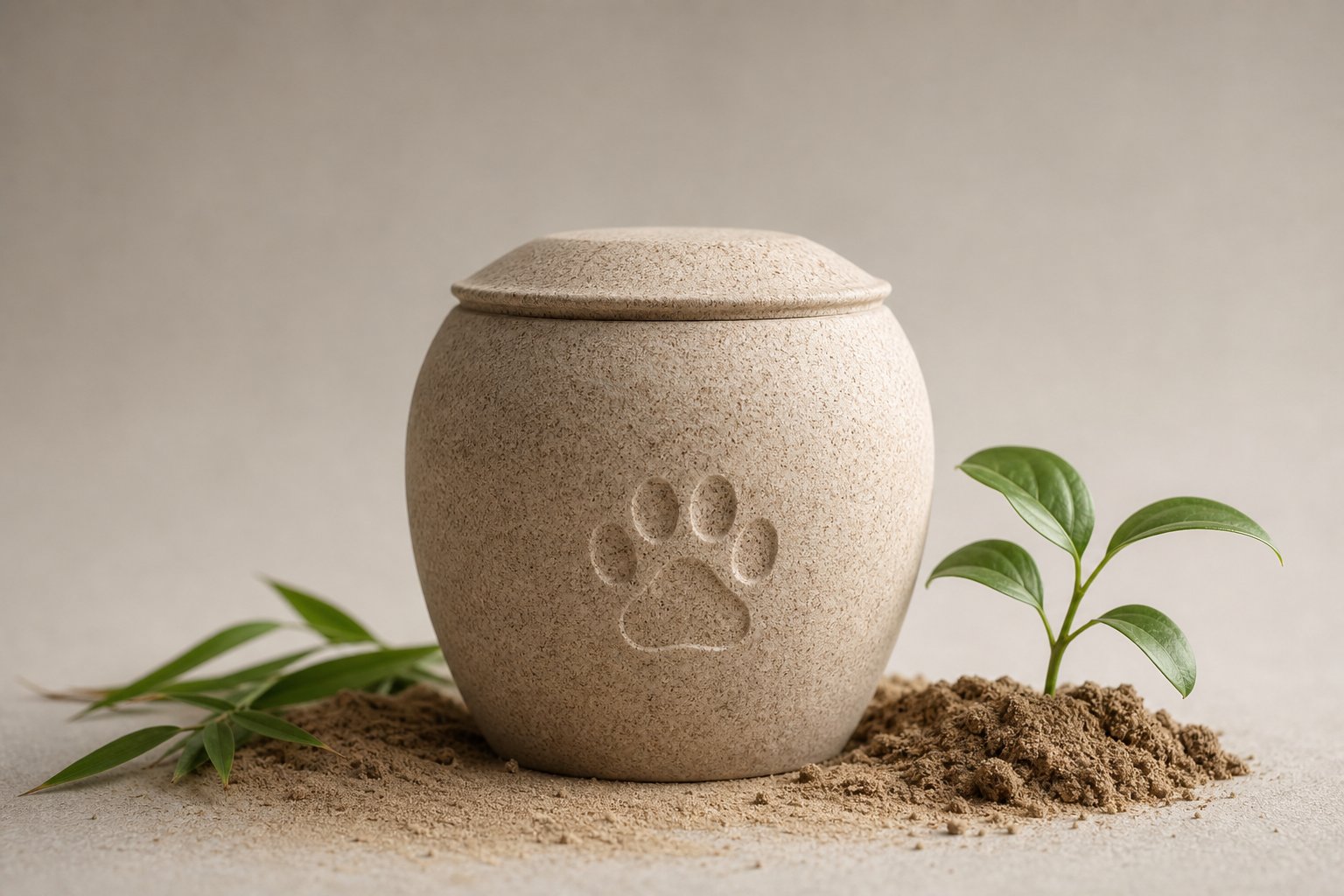
Biodegradable urns are often pitched as the future that replaces traditional urns. Retail data and common sense both say otherwise: they are not competitors but answers to different questions. A family that wants the ashes on the mantel and a family that wants the ashes returned to the garden are standing in the same aisle for opposite reasons. This guide helps you decide what to stock, in what proportion, and how to phrase the eco claims without writing checks your supplier documents cannot cash.
The decision table
| Factor | Traditional urns | Biodegradable urns |
|---|---|---|
| Family intent | Keep ashes at home, in a niche, or split into keepsakes | Bury the whole vessel in soil, or scatter on water |
| Typical materials | Wood, ceramic, metal, crystal, resin | Willow, bamboo fiber, paper pulp; water-soluble formulations |
| Setting | Indoor display; permanent placement | Garden, memorial ground, cemetery plot, water |
| Time behavior | Stable for decades; becomes an heirloom object | Designed to break down after burial; timelines vary with soil, moisture and temperature — state conditions, not promises |
| FOB magnitude | Roughly USD 3-15 by material and size | Roughly USD 3-10 by size tier, three tiers covering small to large pets |
| Claim discipline | Material and capacity accuracy | Material composition plus degradation conditions, in writing |
| Best customers | Memorial retailers, vet clinics, gift channels | Garden-focused retailers, service providers, eco-minded DTC brands |
Why demand for the green line keeps building
The structural tailwind is real. Cremation remains the dominant aftercare — 66 percent of global pet funeral services revenue in 2025 (Grand View Research) — and the same report identifies burial as the second fastest-growing service segment, which is precisely the demand green burial products attach to. Meanwhile the number of families that want a farewell ritual with nothing permanent left behind keeps rising, especially in markets where private burial is restricted.
Rules shape where each line sells. France prohibits private pet burial outright, including in gardens, and restricts pet cemeteries to public institutions under the 1976 law (service-public.fr) — so French demand concentrates on urns and cemetery products, with biodegradable vessels selling as ceremonial and interment-at-cemetery items. The Netherlands and Germany allow burial of a pet, or its ashes, on private land under conditions — roughly one metre deep and away from water in the Netherlands (Regulation EC 1069/2009), about 50-80 cm of cover in Germany — which is where garden-oriented biodegradable lines perform best. In the United States, rules vary by state and locality, so your customer service team should always ask where the interment will happen.
Sourcing notes worth knowing
- The willow supply chain is mature, not experimental. China's willow-weaving counties have exported for decades; Funan county's willow industry generates annual output near RMB 10 billion and ships to more than 120 countries (Anhui News, 2024). Natural fiber weaving translates directly into pet caskets and urns.
- Three size tiers cover the market. A 0-35 kg three-tier program covers most dogs and cats; larger animals are better served by keepsake portioning than by giant vessels.
- Water-soluble is a separate sub-line. Different storage requirements, different customer education, and rules that vary by body of water — treat it as its own SKU family, not a variant.
- Documentation ships with the goods. Material composition sheets and use-condition cards are part of the deliverable for this line, not an afterthought — they are what your listings will quote.
How the two lines work together on the shelf
- Merchandise by intent, not by material. Signpost one section as keep-and-display and one as return-to-earth; customers self-select faster when the aisle mirrors their decision.
- Bridge the two with keepsakes. A family can keep a small share in a keepsake urn and return the rest in a biodegradable vessel — this pairing raises the basket and serves both feelings at once.
- Train the rules question. Before selling any burial product, ask where it will be used. The answer determines product, sizing and aftercare advice.
- Browse the range: our biodegradable product line covers willow, bamboo-fiber and water-soluble urns in three tiers, MOQ from 200 pcs.
FAQ
Do biodegradable urns degrade while sitting on a shelf or at home?
They are designed to remain stable in dry, indoor storage — degradation requires the conditions of soil: sustained moisture and biological activity. Store them dry and they hold; instruct customers to do the same.
Can a family keep the ashes first and bury the urn later?
Yes, and it is a common pattern: the ashes are transferred into the biodegradable vessel whenever the family is ready — weeks, months or on an anniversary. There is no technical time limit; the vessel waits as well as any box.
What materials are biodegradable pet urns actually made of?
Woven natural fibers — willow above all — plus bamboo fiber and molded paper pulp for the vessel body, and water-soluble formulations for water scattering. Insist on written composition for each SKU; it is the basis of every claim you will publish.
How should my store phrase the eco claims?
State material plus conditions: what it is made of, and under which conditions it breaks down. Avoid absolute guarantees and unqualified percentages, and keep test or composition documents accessible in case a marketplace asks.
Sources & notes: Grand View Research (2025) pet funeral services report — cremation at 66 percent of revenue, burial as second fastest-growing segment; service-public.fr on French pet burial prohibitions and the 1976 law; Regulation (EC) No 1069/2009 as applied in the Netherlands; German private-land burial practice as commonly reported; Anhui News (2024) on Funan willow industry output and export reach. Degradation behavior stated as conditions, not fixed timelines (industry good practice). FOB magnitudes and size tiers follow PAWSANGEL biodegradable line specifications.
Ready to stock both intents — keep and return?
Send us your market and burial rules; we configure a traditional-plus-green assortment with documentation included — reply within 12 business hours.