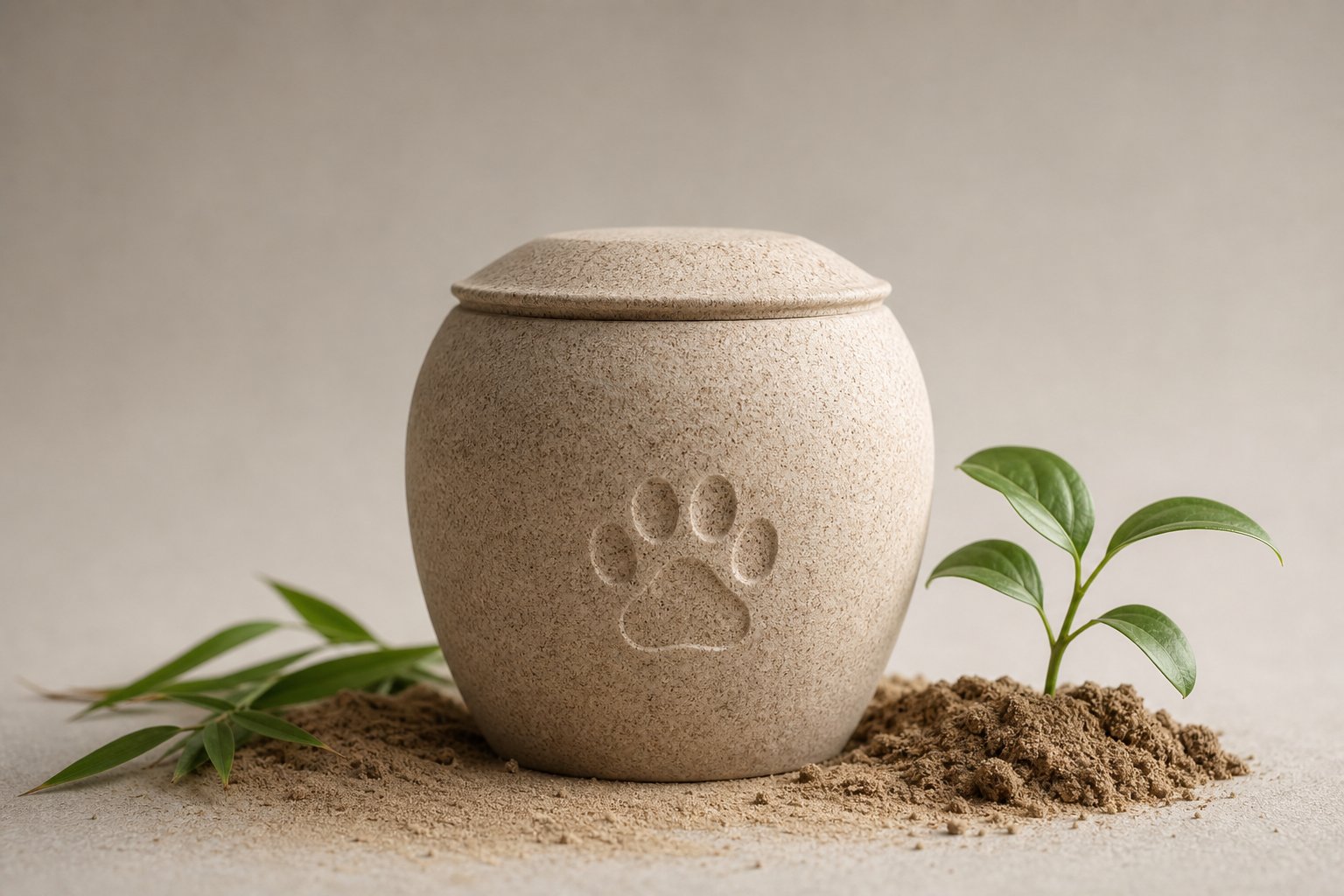
"Green" aftercare has moved from niche to expectation for a growing share of families, and retailers now carry products for it as a normal line item. Within that line, two urn types are constantly confused: the water-soluble urn and the earth-burial urn. Both return a pet to nature, but they are engineered for different environments, follow different timelines and sell into different legal contexts. Confusing them in a listing creates returns and, worse, ruined ceremonies. Here is the clean separation.
The two urn types compared
| Dimension | Water-soluble urns | Earth burial urns |
|---|---|---|
| Designed environment | Water — lake, sea or river ceremony | Soil — garden, woodland or cemetery plot |
| Common materials | Salt- or sand-based shells and paper pulp (common industry practice) | Willow, bamboo fiber, pulp, untreated wood |
| Timeline | Begins dispersing soon after contact with water; pace varies with material and conditions | Gradual, over seasons, depending on soil moisture and contact |
| Construction | Sealed and moisture-sensitive until use | Natural-fiber construction; no special storage |
| Handling duty | Keep dry; desiccant and rigid box until the day | Ordinary dry storage |
| What customers must check | Local rules for scattering in the chosen waterway | Local rules for burial on the chosen ground |
Water-soluble urns in practice
A water-soluble urn turns scattering into a ceremony with a visible, dignified arc: the urn is lowered or set afloat, water takes it, and nothing man-made is left behind. Families choose meaningful water bodies — and that is where the retailer's duty lies, because permissions for scattering differ by jurisdiction and waterway authority. Product-side duties are just as concrete: these urns must survive warehousing and shipping in dry condition, so desiccant, a sealed liner and a rigid outer box are part of the specification, not an accessory. Innovation in this space continues — Grand View Research notes ashes-to-reef projects in the UK as an example of how water memorials are evolving (Grand View Research, 2025).
Earth burial urns in practice
Earth-burial urns trade ceremony for placement: the family chooses a spot, buries the urn, and marks it — often with a memorial stone. Natural materials carry the story. Willow is the anchor craft: Funan county in Anhui, a national-level intangible-cultural-home of willow weaving, runs a willow industry with annual output near 10 billion RMB and exports to more than 120 countries (Anhui official media, 2024). Degradation is honest biology, not a slogan — it proceeds over seasons and depends on soil, moisture and contact, which is exactly why the product page must state conditions rather than promise miracles. Our biodegradable line covers 0–35 kg body weights in three tiers with willow, bamboo-fiber and pulp constructions.
The legal map decides demand
Where families may bury a pet at home shapes which of the two products a market needs. In the United States, backyard burial is governed state by state and sometimes county by county, so the safe retail posture is a standing note advising customers to check local rules (see our state-by-state overview). France is the strict case: pet cemeteries may only be operated by public institutions under the 1976 law, and official guidance prohibits burying a pet at home, gardens included (service-public.fr). The Netherlands allows burying one's own pet in one's own garden — an exception under the EU animal by-products framework — with roughly one meter of depth and distance from water. Germany generally permits burial on one's own land with 50–80 cm of cover. Where home burial is restricted, ceremonial water scattering and keepsakes dominate; where gardens are open, earth urns and memorial stones sell together as a set.
What buyers should verify before stocking
- Material composition in writing — the actual fiber or salt content, not a marketing label.
- Degradation conditions stated on the listing — what environment, what timeline, what happens in dry storage.
- Load ratings by body weight — follow the tiers; overfilling is the top field complaint.
- Ceremony-day packing — for water-soluble urns, confirm desiccant, liner and rigid box are standard.
FAQ
How fast does a water-soluble urn disperse?
It begins taking water as soon as contact is made, and the pace depends on the material and water conditions. These urns are engineered for the ceremony itself, not for storage in humid places — which is why dry packing matters until the day.
Can a family keep an earth burial urn indoors first?
Yes. Most families use it as a display urn until the burial they have planned. Degradation proceeds in soil with moisture; indoor dry display does not start it.
Which markets favor each type?
Water scattering has strong followings in coastal and lakeside regions and wherever home burial is restricted. Garden burial products sell where rules allow it — parts of the US, Germany, the Netherlands — and pair naturally with memorial stones.
Do these urns have weight limits?
Yes — follow the body-weight tiers on the specification. Our biodegradable line covers 0–35 kg in three tiers; matching weight to tier prevents the most common field failures.
Sources & notes: Grand View Research pet funeral services report (2025), including the UK ashes-to-reef reference; service-public.fr on French pet burial rules (1976 law No. 76-541); Netherlands and Germany practices per European national guidance summaries; Anhui official media on Funan willow industry (2024). Material tiers follow PAWSANGEL product specifications; material descriptions reflect common industry practice.
Planning a green line for your market?
Tell us which ceremonies your customers choose; we will match water-soluble and earth-burial SKUs with the right documentation — reply within 12 business hours.