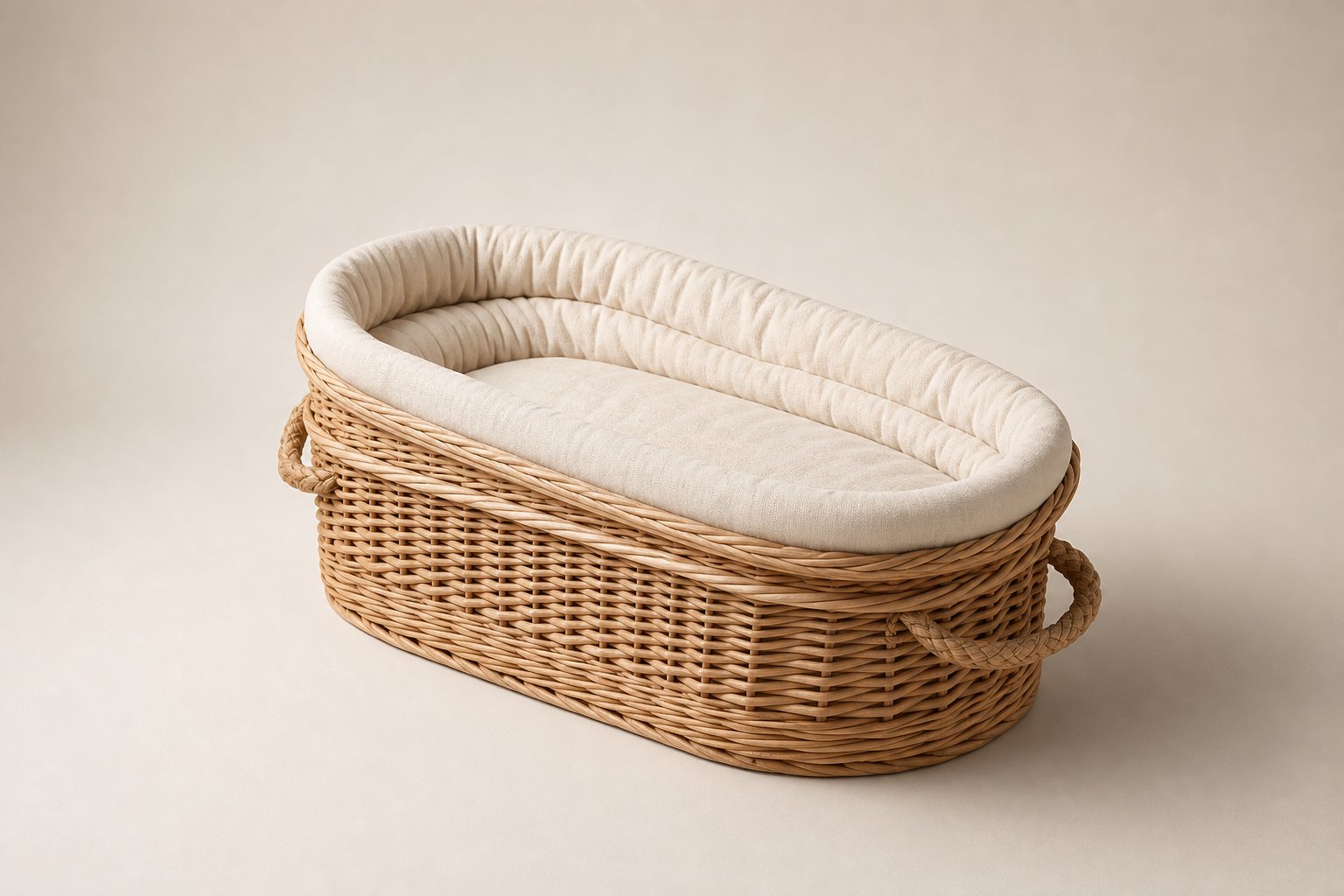
A biodegradable pet casket is a farewell container made from natural, minimally processed materials — woven willow, bamboo fiber, paper pulp, untreated softwood — chosen so that the container itself returns to the soil rather than remaining in it. It answers a growing preference: families who lived with a pet outdoors, in gardens and parks, often want the farewell to end in the ground in the gentlest form available. Interest in burial options is visible in the market data too — Grand View Research identifies burial as the second fastest-growing segment of pet funeral services (Grand View Research, 2025).
The materials, compared
| Material | Character | Best suited for | How it behaves in soil |
|---|---|---|---|
| Woven willow / wicker | Hand-woven plant fiber; warm, basket-like appearance | Ceremonies and burial; the classic green-casket look | Fiber softens and returns to soil naturally over time |
| Bamboo fiber | Fast-growing plant source; smooth pressed panels | Families who want a neater, modern eco finish | Breaks down progressively in moist soil |
| Paper pulp and cardboard | Light, printable, economical | Entry-level ceremonies; providers' basic tiers | Softens quickly in contact with ground moisture |
| Water-soluble materials | Engineered to soften and disperse in water | Water ceremony urns (ashes, not bodies) | Dissolves over hours to days depending on water conditions |
| Untreated softwood (paulownia, pine) | Light wood, no heavy lacquer | Wood-look caskets that still return to nature | Decays naturally like any untreated timber |
How long does decomposition actually take?
Honestly: it depends, and any listing that promises a precise timeline is overclaiming. Breakdown speed is governed by soil type, moisture, temperature and material thickness — a thin willow shell in warm, damp, loamy soil behaves very differently from the same casket in cold clay. The responsible framing for buyers and listings is qualitative: natural-fiber caskets are designed to soften and integrate with the soil over time, with conditions determining the pace. Water-soluble urns — a companion product in the same eco line — are likewise described by conditions, not by fixed hour counts. This is not hedging for its own sake: environmental claims that cannot be substantiated are exactly what marketplace policies and advertising rules in the US and EU are written against.
Where families use them
- Green sections of pet cemeteries. More cemeteries reserve natural-burial areas where only untreated containers are accepted — willow and softwood caskets are the standard entry ticket.
- Home gardens, where permitted. Rules on backyard pet burial vary by state and municipality in the US, and some countries restrict it; sellers should present the casket for ceremony use and leave legality to local guidance.
- The farewell itself. A woven casket gives a ceremony a gentle, natural visual — and in flame cremation, natural-fiber caskets can be cremated together with the pet where the provider allows it.
What B2B buyers should know before stocking
The supply side is more industrial than the handmade look suggests. Willow weaving is a mature export craft in China: Funan county in Anhui — a nationally recognized "home of willow weaving", with the craft listed as national intangible cultural heritage — runs a willow-products industry with annual output near 10 billion RMB and exports to more than 120 countries (Anhui News/中安在线, 2024), while neighboring Gushi ships over 300 million RMB of willow products a year (China Customs media, 2025). In our program, biodegradable caskets and urns run three size tiers covering pets up to 35 kg, with FOB levels in the $3–10 range depending on size and weave density, MOQ from 200 pcs.
Two practical notes for listings: first, natural-fiber caskets need reinforced internal framing so they survive courier handling — our lines use an internal frame plus protective liner, packed to the Amazon 125 cm drop-test practice for fragile goods (Amazon Seller Central). Second, weights and dimensions belong on the listing: eco caskets look light but bulk matters in freight math.
FAQ
How long does a biodegradable casket take to break down?
It depends on soil conditions — moisture, temperature, soil type and material thickness. The honest, listing-safe framing is qualitative: natural-fiber caskets are designed to soften and integrate with soil over time. Avoid precise hour or month promises.
Can a biodegradable casket be used for cremation?
Natural-fiber caskets such as willow and untreated softwood are generally suitable for cremation together with the pet, where the provider allows it. Confirm with the service provider, as facility policies differ.
Are they sturdy enough for shipping and daily handling?
Yes, when engineered for e-commerce: an internal frame, a protective liner, and packing to the drop-test practice used for fragile goods. Ask suppliers how their eco line is reinforced before comparing prices.
Do biodegradable caskets cost more than wooden ones?
They sit in a comparable range. In our program, biodegradable caskets and urns run roughly $3–10 FOB depending on size and weave — alongside wooden caskets at $4–18 — so an eco tier can be added without repricing the line.
Sources & notes: Grand View Research (2025), pet funeral services market (burial as second-fastest segment); Anhui News/中安在线 (2024) on Funan willow-weaving industry output and export reach; China Customs-affiliated media (2025) on Gushi willow exports; Amazon Seller Central fragile-goods packaging practice. Decomposition timelines are deliberately qualitative — speed depends on soil conditions (industry-wide understanding).
Adding an eco tier to your range?
Willow and bamboo-fiber caskets quoted by size tier, with samples and MOQ from 200 pcs — reply within 12 business hours.