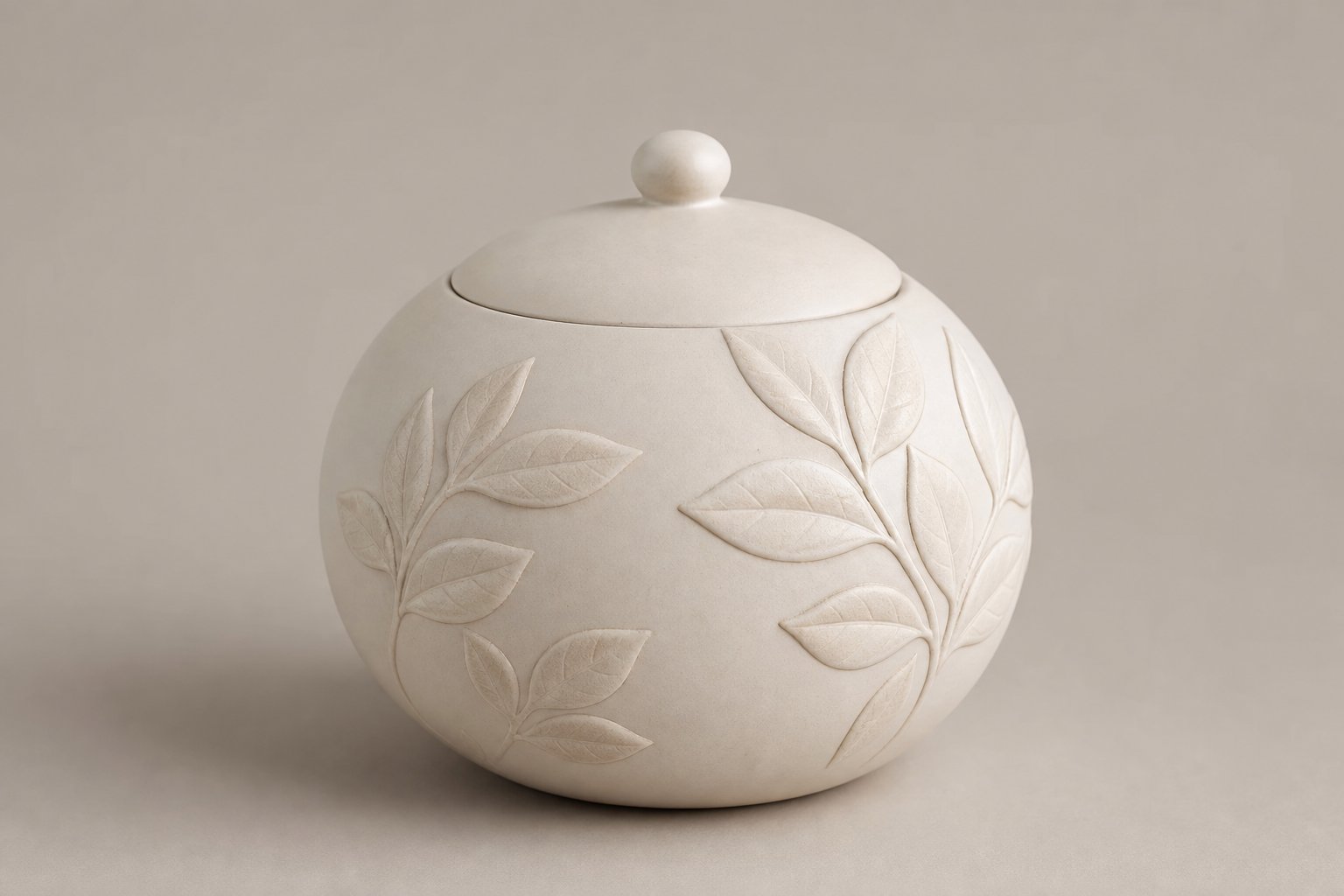
Urn sizing is the most consequential product question in pet aftercare retail. Get it right and the purchase is invisible — the family receives the ashes, the urn holds them, life continues. Get it wrong and the mistake arrives at the worst possible moment: an urn that cannot hold all the ashes is a guaranteed return, a reshipment, and a second grief for the customer. This guide turns sizing into a repeatable decision your team and your customers can make in under a minute.
The rule of thumb that does most of the work
Cremated remains scale with body weight, and the funeral industry's working convention carries straight over to pets: one pound of body weight corresponds to roughly one cubic inch of urn capacity. In metric, plan for about 60–70 milliliters of capacity per kilogram. The pet's healthy weight before passing is the number to use.
| Body weight | Capacity to look for | Typical form |
|---|---|---|
| Up to 10 kg (22 lb) | up to 0.7 L (about 40 cu in) | Keepsake or small urn |
| 10–20 kg (22–44 lb) | 0.7–1.4 L (40–85 cu in) | Small-medium urn |
| 20–30 kg (44–66 lb) | 1.4–2.1 L (85–130 cu in) | Medium urn |
| 30–40 kg (66–88 lb) | 2.1–2.8 L (130–170 cu in) | Large urn |
| Over 40 kg (88 lb) | 2.8 L+ (170 cu in+) | Extra-large urn or paired urns |
For the full worked chart — including per-style recommendations and clinic handout tips — see our pet urn size chart by weight. This article covers the decisions around the number.
Three questions to ask before the number
1. Are the ashes staying together, or being divided?
Many families split ashes: a main urn at home, small keepsakes for relatives, occasionally a portion for a garden burial. Dividing does not shrink the main urn by much — a keepsake holds only a small portion — but knowing the plan changes what belongs in the basket: a main urn plus one or two mini keepsake urns, rather than a single large piece.
2. Flame cremation or aquamation?
Aquamation, which is legal for pets in all 50 US states (American Animal Hospital Association), returns more remains by volume than flame cremation — typically around 20–30% more, since bones are not reduced at high temperature. A 25 kg dog that lands at the top of the 1.4–2.1 L band after flame cremation may genuinely need the next tier after aquamation. If your market has aquamation providers, label both capacities.
3. Display, burial, or both?
An urn for a shelf is chosen by capacity and style; an urn or casket for the garden adds weather resistance and, for burial, material behavior over time. The capacity math stays the same, but the product shortlist changes — memorial stones and biodegradable urns play by different rules than lacquered wooden boxes.
What this means for retailers' listings
- State capacity in both units, plus the weight it suits. "2.1 L — suits pets up to about 30 kg (66 lb)" does the conversion for the customer and prevents most sizing tickets.
- Photograph with scale. Urns shot on an empty table read larger than they are. A dimensioned line drawing and one lifestyle photo with a reference object cut "smaller than expected" reviews.
- Stock the middle of the curve. Most dogs and cats fall in the 10–30 kg bands; a five-SKU range spanning 0.3–3 L — the capacity spread of our wooden urn line — covers the great majority of families.
- Pair every main urn with a keepsake. Mini urns cost little and complete the emotional set; they also give uncertain buyers a graceful fallback when a main urn is out of stock.
FAQ
How do I convert weight to urn capacity quickly?
In imperial: the pet's weight in pounds is the required capacity in cubic inches. In metric: multiply weight in kilograms by about 65 to get milliliters, then round up to the nearest product tier.
Do cats and dogs need different urn shapes?
Capacity decides, not shape. As a presentation tendency, cat urns run smaller and taller while dog urns run wider and lower — worth reflecting in a product line, but never at the cost of capacity.
What about very large dogs, or two pets in one family?
For giant breeds, choose extra-large urns or two matched urns; for two pets, a companion urn with an internal divider is the standard solution, and dividing walls are a routine OEM option on wooden and ceramic models.
Does the size rule change if the family wants keepsakes too?
Only slightly — a keepsake holds a small portion, so the main urn's capacity barely changes. The basket changes more than the number: main urn plus one or two mini urns is the configuration most families actually need.
Sources & notes: the 1 lb ≈ 1 cu in convention is a funeral-industry rule of thumb; aquamation legality for pets in all 50 US states per the American Animal Hospital Association; US cremation cost ranges and base urn pricing per CareCredit/Synchrony (2023), pet cremation cost guidance. Capacity tiers follow PAWSANGEL product specifications.
Need a size ladder for your catalog?
Send us your customer weight mix — we map urn capacities to it and quote per tier, MOQ from 100 pcs.