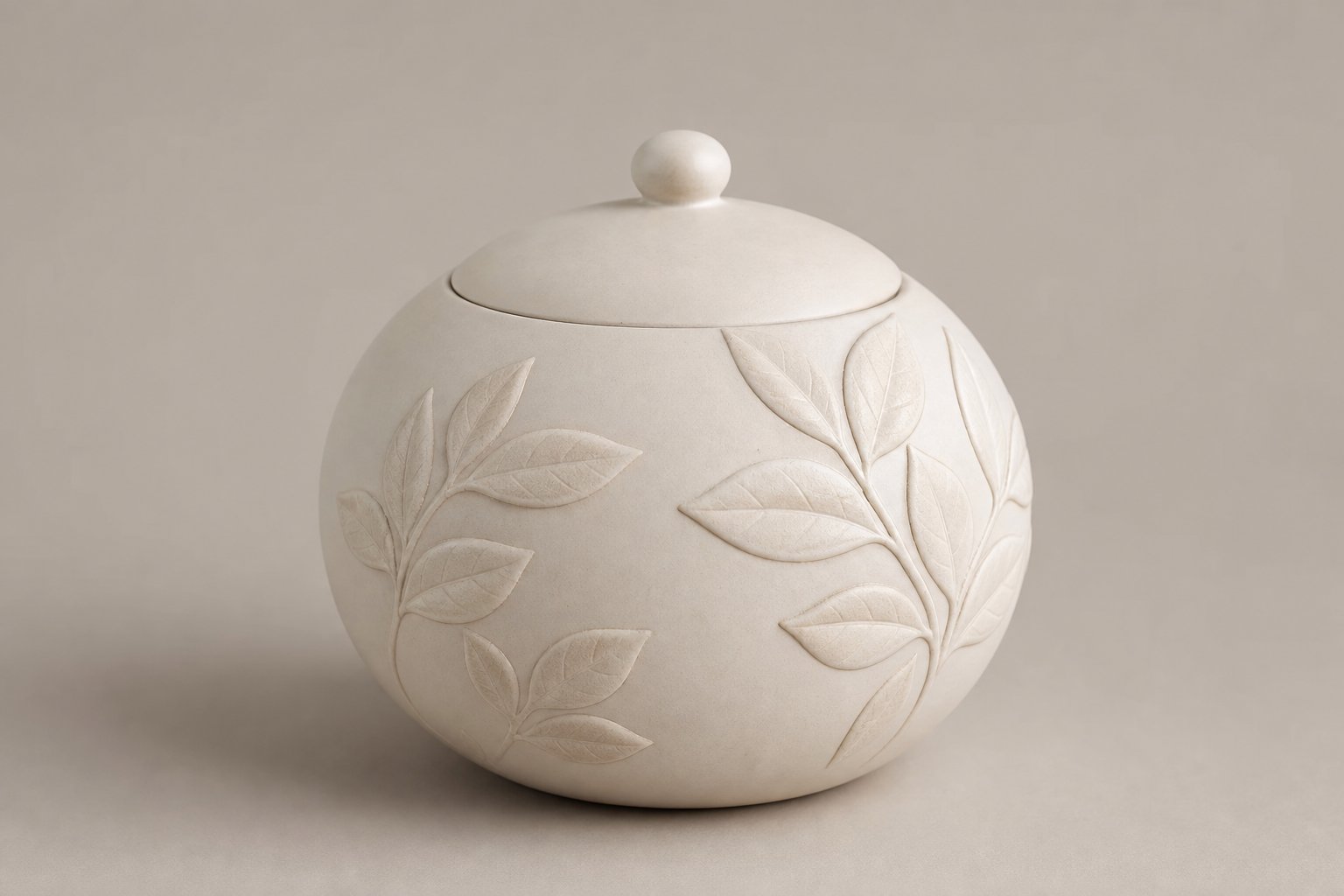
Ask a room of memorial retailers whether cat urns and dog urns are different products and you will hear two camps. One says they are the same product at different volumes. The other — closer to what customers actually buy — says the size curve, the silhouette language and even the market mix differ enough to treat them as related but distinct lines. This article walks through what genuinely differs, with the numbers behind it.
The design dimensions that actually differ
| Design dimension | Cat urns | Dog urns |
|---|---|---|
| Capacity sweet spot | 0.3–1.0 L (most cats under 10 kg) | 0.7–2.8 L (most dogs 10–40 kg) |
| Typical proportions | Taller vessels, narrower footprint | Wider bodies, lower center of gravity |
| Motif conventions | Sleeping cat, curled tail, moon-and-cat, whisker line art | Breed figures, paw print, angel wings, name plaques |
| Surface language | Smooth glaze, coat-color palettes (white, grey, cream) | Wood grain, engraved panels, brass bands |
| Display context | Mantel and shelf, close to daily life | Console, memorial corner, garden in larger sizes |
| Keepsake behavior | Frequently bought in small sets for family members | Main urn plus one or two keepsakes |
The market numbers behind the split
Species mix differs by market, and your size curve should follow it. In the US, dogs outnumber cats — 87.3 million dogs versus 76.3 million cats (AVMA, 2025), with 53 percent of households owning dogs and 39 percent owning cats (APPA, 2025). Within funeral services, dogs hold the largest species share while cats are the fastest-growing segment (Grand View Research, 2025). Japan runs the other way: about 8.84 million cats to 6.82 million dogs (Japan Pet Food Association survey, 2025) — a Japan-facing assortment should weight small urns heavily. The UK sits between: about 15.5 million dogs and 13 million cats (UK Pet Food, 2026). The practical conclusion is that "cat versus dog" is not only a design question; it is a per-market stocking question.
Silhouette and proportion
Because cats are light, their urns live in the small tiers — and a small vessel that sits low reads "pet dish" on a shelf. Raising the proportion, narrowing the footprint and letting the silhouette suggest a curled cat fixes the perception problem while staying within capacity. Coat-color palettes matter: many cat owners look for a glaze or painted finish that recalls their pet's coloring. Dog urns answer a different physics: larger volumes demand wider, more stable bases, and the category's most durable sub-line is the breed figurine urn — a recognizable silhouette of the breed doing what it did in life, curled at rest.
What families actually ask for
- "At rest" poses, not distressed ones. The sleeping, peaceful posture is the convention families respond to on both lines.
- Name and dates, discreetly placed. Engraving on the base or a small plaque; loud personalization reads poorly in this category.
- Keepsakes for splitting. Multi-pet and multi-family households buy a main urn plus minis — the easiest honest upsell in the category.
Stocking advice
A five-SKU capacity curve from 0.3 to 3 L covers the large majority of cats and dogs — the structure of our wooden urn line — with one extra-large option for giant breeds. Weight the low end further for cat-heavy markets such as Japan, and the middle tiers for dog-heavy ones such as the US. Pair every main urn with a keepsake option in the same design language so the set photographs as one family.
FAQ
Is the capacity formula different for cats?
No. The rule of thumb — one pound of body weight to one cubic inch of capacity, or roughly 65 ml per kilogram — applies to every species. What differs is where each species lands on the curve.
Do cat owners prefer different materials?
Cat urns skew toward lighter, glazed or painted pieces displayed on mantels and shelves. Dog urns more often use wood and metal at larger capacities. Both audiences engrave names and dates; the display surface, not the species, drives the material choice as much as anything.
What about households that had both a cat and a dog?
Offer a companion urn with a divided chamber, or paired urns in one design language. Dividers are a standard OEM option on wooden and ceramic models.
Which sizes should a new assortment launch with?
Launch in the middle of the curve — roughly 0.7 L and 1.4 L equivalents — then extend downward for cat-heavy markets and upward for large-breed demand once review and sales data arrive.
Sources & notes: AVMA US pet ownership statistics (2025); APPA State of the Industry news release (2025); Grand View Research pet funeral services report (2025); Japan Pet Food Association national dog and cat survey (2025); UK Pet Food population data (2026); American Animal Hospital Association on aquamation. Capacity tiers follow PAWSANGEL product specifications.
Tuning a size curve for your market?
Send us your species mix and price tiers; we will propose an assortment with capacities, glazes and MOQs to match — reply within 12 business hours.