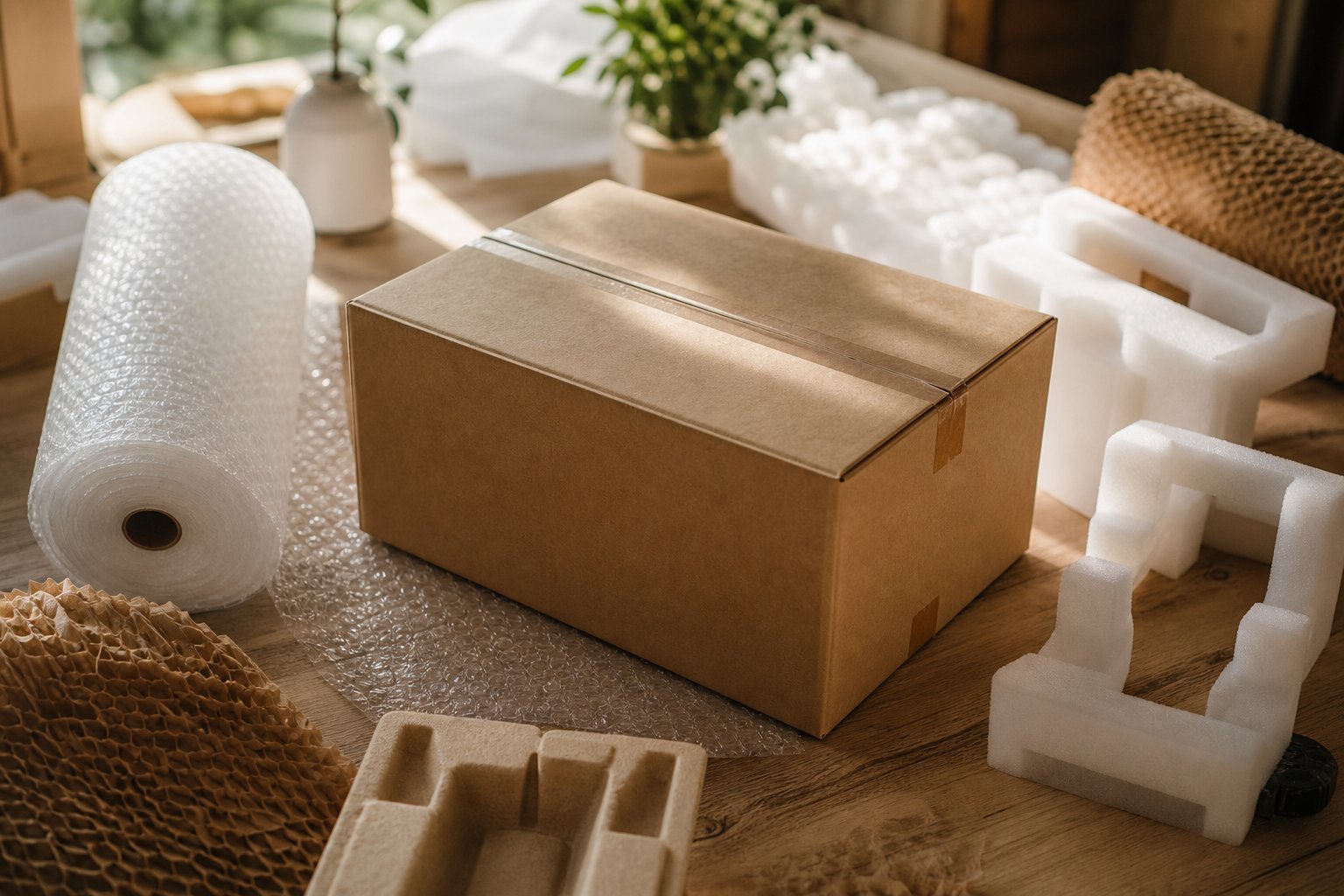
Ceramic urns, crystal keepsakes and stone memorials are the heaviest, most brittle products in the grief category — and the ones where a shipping failure costs more than a refund. A broken memorial can arrive weeks after the loss, to a family at their most fragile moment. One parcel becomes a service failure, a review problem, and a reorder under time pressure. This checklist walks the full journey from packing bench to doorstep, stage by stage, so your team can audit any supplier — or your own fulfillment — against it.
The stage-by-stage checklist
| Stage | What to do | Common failure |
|---|---|---|
| Before packing | Inspect glaze and edges; ensure pieces are fully cured, clean and dry | Packing a warm or unsteady glazed piece; hairline cracks sealed inside the box |
| First wrap | Individual wrap per piece — tissue or bubble, no two items touching | Batch-wrapping keepsakes together; they chip each other in transit |
| Inner cavity | Cut or molded foam with a fitted slot; walls 25–30 mm around the piece (typical workshop practice) | Loose peanuts that settle; a cavity the piece can migrate in |
| Inner box | Rigid single-wall box around the cavity, sealed | Sending the molded insert loose inside the outer carton |
| Outer box | Double-wall corrugated; fill remaining voids; H-tape all seams | Single-wall carton for pieces over ~2 kg; one strip of tape |
| Cartonization | Heavy fragile goods on their own; no stacking of dense cartons on top; desiccant for sea freight | Mixing heavy stone boxes with softgoods; moisture staining on stone and slate |
| Labels & docs | Fragile marking on at least two faces; ISPM15/IPPC mark on any solid-wood crate | Treating a label as packaging; unmarked wooden crates held at customs |
The 125 cm drop test, in plain terms
Amazon's seller packaging requirements state that glass and ceramic products must be packaged individually, protected against collision, and survive a 125 cm drop test without damage, in a sturdy six-sided box or fixed securely in bubble wrap (Amazon Seller Central). Even if you never sell on Amazon, the standard is a useful engineering benchmark: it approximates the height of a casual drop from a conveyor or the back of a van.
A practical internal test sequence, used widely in the industry: drop the packed carton flat on its base, then on each of the two longest edges, then on a corner — nine to ten impacts in total against a hard surface. Open and inspect after each. If the piece survives the full sequence, your pack is ready for a sample order; if not, add cavity density before you add carton thickness (industry practice).
Channel differences worth budgeting for
- Express and air. Fewer handlings, but higher drop energy per handling. Cavity quality is the variable that matters.
- Sea freight. Weeks of humidity and container condensation. Add desiccant packs and consider kraft-lined cartons for stone and slate, which can show moisture staining (industry practice).
- Dropship singles. Every parcel is a first impression. This is where protective packing standards and neutral, grief-appropriate outer packaging must both hold — see our dropship fulfillment notes.
What PAWSANGEL does by default
For ceramic, crystal and stone lines we pack to a standing policy: each piece in its own foam cavity, double-carton by default, packed to the Amazon 125 cm drop test standard. First bulk orders include 2% spare pieces, and any breakage that arrives is replaced piece-by-piece against photos within the 30-day quality window. The policy is written into our quality and compliance terms so both sides know the remedies before the first PO.
FAQ
Do "Fragile" labels actually reduce breakage?
Modestly at best. They influence the last mile more than the sortation hub. Packaging engineering — cavity, double-wall, void fill — does the real work; treat labels as a supplement, never a substitute.
What packaging does Amazon require for fragile items?
Glass and ceramic products must be individually packaged, protected against item-to-item collision, and pass a 125 cm drop test without damage, using a sturdy six-sided box or full secure wrapping in bubble material (Amazon Seller Central packaging requirements).
Do wooden crates need ISPM15 treatment?
Solid-wood packaging for international shipment must be heat-treated or fumigated by a customs-approved facility and stamped with the IPPC mark under ISPM15 (China customs guidance). Deep-processed panels such as plywood and MDF are generally treated as processed material, but confirm with your forwarder per destination.
Who pays when a piece arrives broken?
Whatever your supplier agreement says — so put it in writing. Our standing policy: 2% spares in first orders, and photo-verified breakage replaced piece-by-piece within the 30-day quality window.
Sources & notes: Amazon Seller Central packaging requirements for fragile goods (individual packaging, 125 cm drop test), sellercentral.amazon.sg; ISPM15/IPPC wooden packaging treatment requirements per China customs guidance, gdfs.customs.gov.cn. Foam wall thickness, drop-test sequence and channel notes reflect industry practice. Replacement and spares terms are PAWSANGEL published policy.
Want your fragile lines packed to this standard?
Request a packing specification sheet with your quote — foam cavities, double cartons, drop test records — reply within 12 business hours.