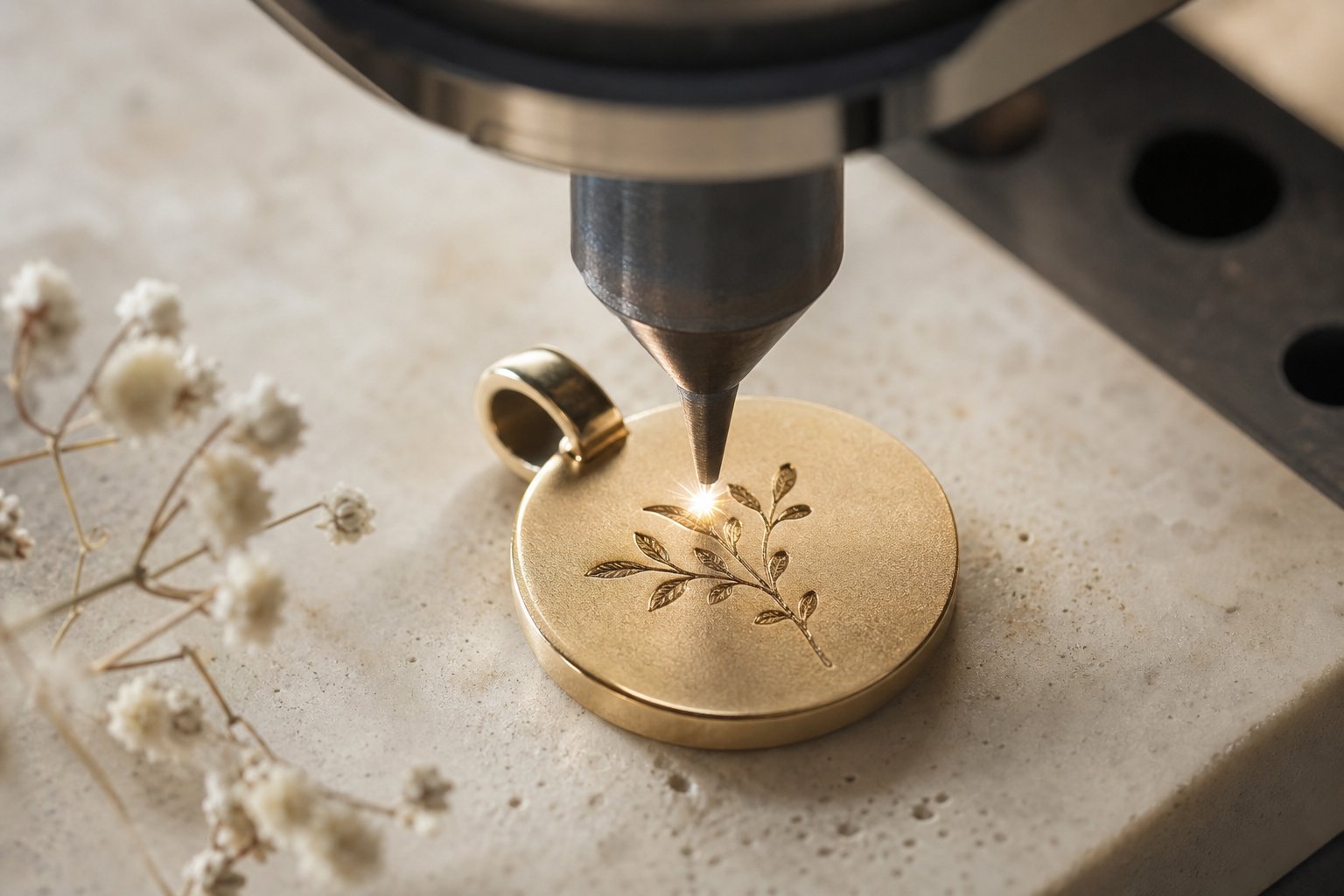
Personalization is no longer a nice-to-have in memorial retail: Grand View Research names personalized memorial products among the demand drivers of the pet funeral category (Grand View Research, 2025 report). Behind nearly every personalized piece in this catalog stand two workhorse processes — laser engraving and UV printing. They are not interchangeable, and choosing between them per SKU is the difference between a tribute that reads as craft and one that reads as an afterthought.
The two processes, side by side
| Aspect | Laser engraving | UV printing |
|---|---|---|
| Principle | Focused beam removes or alters the material surface | UV-cured ink layer applied on the surface |
| Color | Monochrome by nature (material contrast); paint-fill optional | Full color, including white-ink underlayer on dark surfaces |
| Material fit | Wood, slate and stone, anodized metal, leather, coated panels; 3D inner engraving in optical crystal | Ceramic, glass and crystal surfaces, metal, acrylic, coated wood |
| Durability | Structural — no ink to fade; weathers well (industry practice) | Robust ink layer when cured properly; best kept indoors or sheltered; coatings extend life (industry practice) |
| Feel | Etched or debossed, tactile, reads as craft | Flat gloss image, reads as photo |
| Setup & unit cost | Vector file plus machine minutes; no tooling; scales cheap | Image prep plus per-piece print time; no tooling; higher per-unit than engraving |
| Proofing | Engraved sample in 3–5 days (engrave-only samples) | Printed proof panel before the run |
| Best fit | Urn faces, memorial stones, wooden plaques, pendants | Photo plaques, ceramic tiles, crystal surface photos, illustration pieces |
How each process looks on the products you stock
On wood, the laser darkens the grain to a warm brown tone that deepens with the species — names and dates gain weight without any ink at all. On slate, the beam whitens the matte face for high-contrast text. On polished granite, engraving or sandblasting delivers the classic marker look. And in optical crystal, 3D inner laser engraving suspends the paw print and name inside the block — the highest perceived-value treatment in the crystal line (see the crystal keepsake line for the format). UV printing is the photo medium of the pair: a companion's portrait on a ceramic tile or a wooden plaque, in full color, with white ink letting photos sit cleanly on dark surfaces.
Durability and placement
Engraving is structural: the lettering is the material itself, so there is nothing to peel or fade, which is why it remains the standard recommendation for garden stones and ground-contact pieces (industry practice). A UV print is a cured ink layer — durable on a shelf, but still a surface. For pieces that will live indoors or under cover, UV delivers what engraving cannot: the photograph. A practical split for a product line: engrave everything that touches soil or weather; print the photo products that live on mantels and shelves.
The B2B cost logic
Neither process needs a mold — and that is precisely what makes them fit low-MOQ customization. In our engagement tiers, personalized engraving on stock products starts from the private-label tier at 100 pieces, dedicated customization from 500 pieces, with sampling in 7–12 days (engrave-only samples in 3–5 days) and production in 20–35 days depending on process and quantity. Engraving costs machine minutes against a vector file; UV printing costs image preparation plus print minutes per piece. Both scale predictably, which is why personalization can be priced as an upsell rather than absorbed as overhead — the economics of that pricing deserve their own planning, covered in our OEM pages.
- Send vector files (AI/PDF) for engraving and high-resolution photos for UV printing — file quality sets the ceiling on output quality.
- Request a proof panel whenever photos matter; a five-minute render check prevents a production run of regret.
- Define font and line-count rules per product; layout discipline is what separates craft from clutter.
- Split the line by placement: engraved pieces for garden and ground, printed pieces for indoors.
FAQ
Can UV printing put a photo on slate?
Not reliably. Porous, uncoated stone accepts UV ink unevenly; raw slate is an engraving material. For photo reproduction, choose smooth coated surfaces — ceramic tiles, coated wood, glass, crystal — and request a printed proof first.
Which process lasts longer outdoors?
Engraving. It removes or alters the material itself, so weather has nothing to lift or fade (industry practice). UV prints belong indoors or under shelter, where a coating can extend their life further.
What MOQ applies to personalized orders?
Personalized engraving on stock products starts from the private-label tier at 100 pieces; dedicated customization runs from 500 pieces; deep customization such as new molds starts at 1,000 pieces (PAWSANGEL terms).
How fast can we see a sample?
Engrave-only samples in 3–5 days; full sampling in 7–12 days. Production runs 20–35 days depending on process and quantity.
Sources & notes: Grand View Research pet funeral services report (2025/2026) for personalization as a category demand driver; process behavior and durability notes follow industry practice; MOQ tiers, sampling and production lead times follow PAWSANGEL commercial terms.
Not sure which process fits which SKU?
Send your materials and artwork — we advise engraving versus UV printing per product and quote both, reply within 12 business hours.